Real Estate Pitch Deck AI Illustration: Developer Guide
April 10, 2026
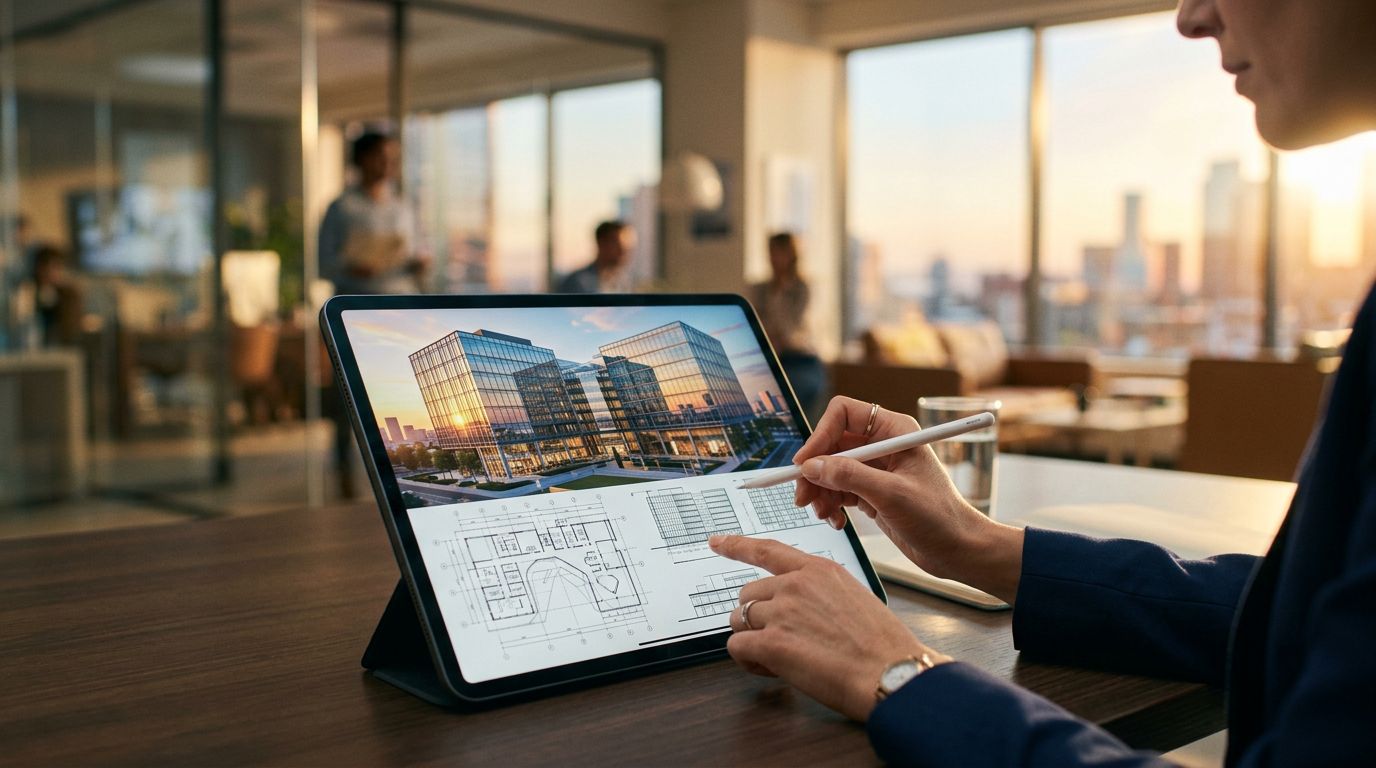
The methodology for securing capital in real estate syndication and commercial development has undergone a structural shift. As of early 2026, 81% of real estate leaders identify AI-driven technology as the primary engine for their growth plans. The days of static, manually assembled PowerPoint presentations—costing upwards of $5,000 and taking weeks to produce—are being replaced by agile workflows centered on real estate pitch deck AI illustration. These tools allow developers to synthesize complex underwriting data into high-fidelity visual narratives in minutes.
For developers and investment managers, the challenge is no longer just finding the right deal; it is communicating the value of that deal with enough precision and visual authority to satisfy increasingly sophisticated LP (Limited Partner) requirements. With the real estate AI market projected to reach $1.3 trillion by 2034 at a 36% CAGR, early adopters are utilizing AI not just for data extraction, but for the creation of immersive property visuals that bridge the gap between pro forma spreadsheets and physical reality. This guide examines how professional developers leverage AI to build investor-ready decks that convert.
#01The Strategic Impact of AI Illustration on Capital Raising
In the current market, speed and data integrity are the two pillars of successful capital raising. Real estate pitch deck AI illustration provides a competitive advantage by automating the repetitive elements of design while enhancing the clarity of technical data. McKinsey estimates that AI initiatives could generate between $110 billion and $180 billion in annual value for the U.S. real estate market alone. A significant portion of this value is realized during the acquisition and fundraising phases.
Traditional workflows often suffer from a disconnect between the financial model and the visual presentation. When a developer updates a pro forma or recalculates the Internal Rate of Return (IRR), the pitch deck usually requires manual revision. Modern AI tools, such as Claude PowerPoint and Hebbia, solve this by reading offering memorandums (OMs) and underwriting models directly. They can recalculate impacts—such as the addition of Accessory Dwelling Units (ADUs) or changes in cap rates—and automatically update the corresponding slides. This integration ensures that the investor narrative is always supported by the most current financials, reducing the risk of data discrepancies during due diligence.
#02Overcoming Developer Pain Points with AI Integration
Real estate developers face specific hurdles when presenting to institutional investors or private equity groups. Here are four common pain points and how AI illustration tools address them:
1. High Costs and Long Turnaround for Renderings
Obtaining professional architectural renders for a pre-construction project can take weeks and cost thousands. Solution: Tools like Alai, powered by Nano Banana Pro, allow developers to generate custom property mock-ups and conceptual illustrations directly within the pitch deck interface. By utilizing AI architectural illustration from photos, developers can provide a visual 'proof of concept' before committing to expensive 3D studio work. This is particularly effective for pre-selling homes with architectural illustrations.
2. Manual Data Extraction from Bulky Documents
Manually pulling sales comps, rent rolls, and submarket data into a deck is prone to human error. Solution: AI engines like Hebbia use Iterative Source Decomposition to analyze datasets and generate source-linked tables. This allows developers to present 'valuation football fields' and market matrices that are directly cited from the raw data, increasing investor trust. This is a critical component for AI property developer off-plan marketing illustrations.
3. Visual Inconsistency Across Portfolios
Maintaining a unified brand voice across multiple deal presentations often requires a dedicated design team. Solution: Platforms like Canva Magic Design and Gamma utilize brand kits to ensure that every luxury real estate marketing illustration adheres to the firm's color palettes, typography, and logo placement. This level of professional polish signals stability and institutional-grade management to potential partners.
4. Demonstrating Renovation Potential
For Value-Add plays, investors need to see the 'after' to believe the pro forma. Solution: AI renovation visualization for realtors can be embedded into pitch decks to show a side-by-side comparison of current conditions versus the proposed finished product. This visual evidence justifies the projected rent premiums and capital expenditure budgets.
#03Top AI Tools for Real Estate Pitch Decks in 2026
The 2026 landscape features specialized tools that cater to the unique requirements of Commercial Real Estate (CRE) and residential development. Unlike general-purpose AI, these tools are built to handle the technical nuances of the industry.
| Tool | Primary Use Case | Key Strength |
|---|---|---|
| Alai (Nano Banana Pro) | Custom property visuals & mock-ups | Generates investor-credible illustrations without complex prompting. |
| Hebbia | Institutional-grade data visualization | Source-linked charts and tables for deep-dive financial transparency. |
| Claude PowerPoint | Re-underwriting & OM updates | Reads full decks and recalculates IRR/pro forma impacts autonomously. |
| Manus | Image-heavy CRE presentations | Superior layout design for large-scale commercial real estate AI illustrations. |
| Gamma | Rapid iteration and deck structure | Excellent for moving from a text-based prompt to a 10-slide investor structure. |
For developers operating in competitive markets, such as those looking for AI illustrations for London homes, these tools provide the ability to produce high-quality collateral that matches the pace of the market.
#04Best Practices for Implementing AI Illustrations
To maximize the ROI of real estate pitch deck AI illustration, developers should follow a structured workflow that prioritizes accuracy and narrative flow.
- Feed the Model Quality Inputs: The output is only as good as the underlying data. Start by uploading the underwriting model, current rent rolls, and high-resolution site photos. Tools like Henry AI can then build deal-ready decks from these specific comps.
- Maintain Human Oversight: While AI tools for real estate operations report 70-90% time reductions, they are not infallible. Expert review is essential to ensure that AI-generated visuals do not misrepresent the structural reality of the site or the local zoning laws.
- Focus on the Capital Stack: Use AI to create clear, hierarchical charts that explain the GP/LP structure and the waterfall of returns. Investors appreciate clarity on how their capital sits in the stack.
- Leverage Geography-Specific Context: If the project is in a specific region, such as Canada real estate visualization, ensure the AI uses regional market data for its comps and visualizations to maintain local relevance.
#05The Future of Real Estate Syndication Narratives
As we look further into 2026, the distinction between a 'pitch deck' and a 'digital experience' is blurring. Developers are now using LTX Studio to generate cinematic property demos that live alongside static slides. By integrating AI interior illustration from photos into the deck, developers can provide a 360-degree view of the investment's potential.
Organizations that fail to adopt these tools risk appearing antiquated to modern investors. The efficiency gains—moving from two hours of manual work to ten minutes of AI-assisted iteration—allow principals to focus on what actually moves the needle: sourcing deals and building relationships. For more specialized use cases, developers may also explore how architects use AI illustration tools for client pitches to gain further inspiration for their investor materials.
Real estate pitch deck AI illustration is no longer an optional luxury for developers; it is a fundamental requirement for efficient capital raising in 2026. By automating the intersection of financial underwriting and visual storytelling, developers can produce presentations that are more accurate, more compelling, and significantly less expensive than traditional methods. As AI adoption among top-performing real estate teams reaches ~90%, the focus must shift from simply using these tools to mastering them as a core part of the development lifecycle.