New Build Site Hoarding AI Illustrations: Developer Guide
April 10, 2026
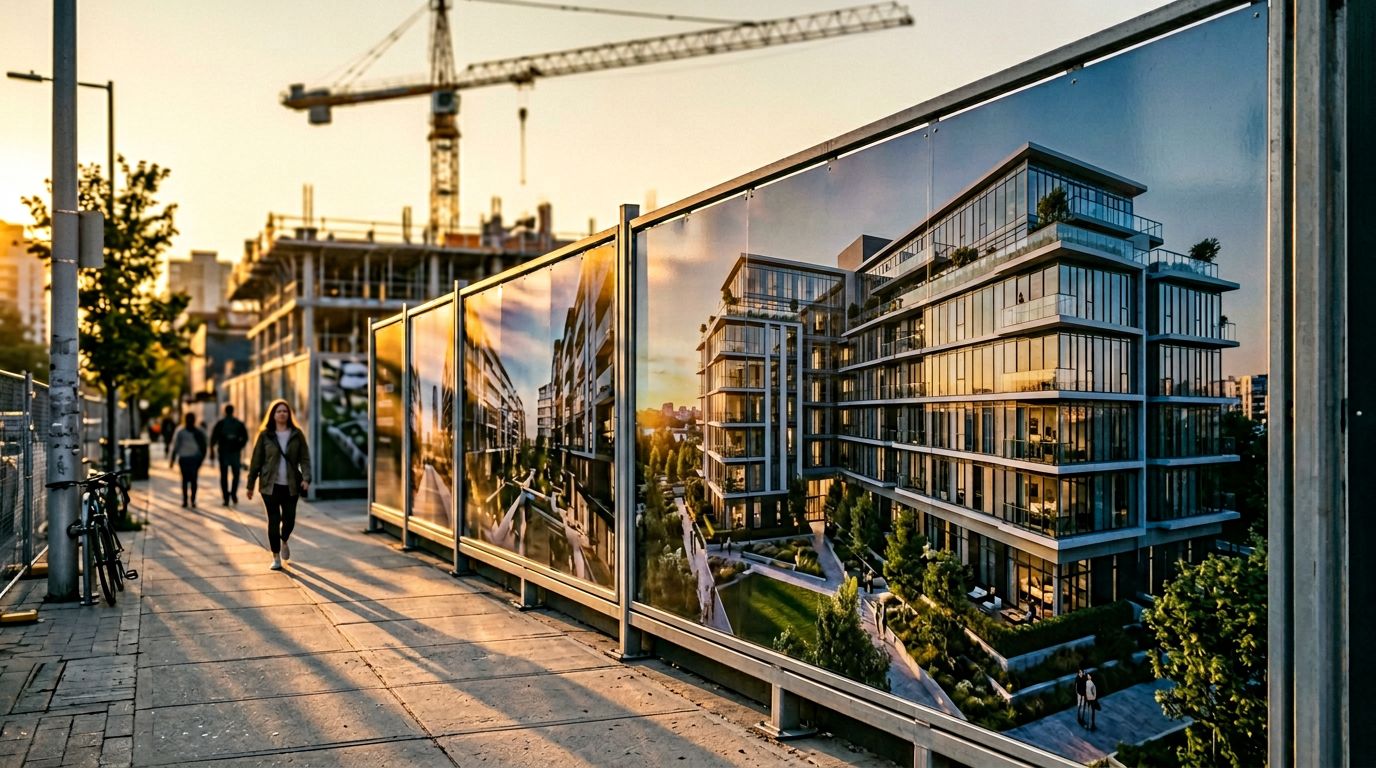
The construction industry is changing fast as project margins drop because of rising material costs, which have gone up 38% since 2020. In this environment, property developers are moving beyond basic site barriers and toward high-impact marketing assets. New build site hoarding AI illustrations represent a major shift in how upcoming developments are shown to the public and potential investors. By using generative design and spatial intelligence, developers can now turn temporary fencing into realistic previews of finished projects.
Traditional methods for producing hoarding graphics often involve long wait times and high costs for 3D rendering. However, with the construction technology market projected to reach $35.4 billion by 2027, the adoption of automated visualization tools is picking up speed. Around 67% of general contractors are currently evaluating or using AI tools in 2025-2026. This guide looks at the strategic implementation of AI-generated visuals for site hoardings, focusing on technical requirements, ROI, and how these tools fit into the broader development workflow.
At Our Store, we recognize that the visual look of a site often sets its perceived value before the first brick is laid. Providing accurate, attractive illustrations is a requirement for keeping project momentum and getting early commitments. This article provides a thorough overview of how to use AI technology to ensure your site hoarding is a powerful 24/7 sales representative.
#01The Strategic Importance of Hoarding in Modern Development
Site hoarding is the primary contact point for a development within the local community. In the past, these barriers were used only for safety and security. In 2026, the standard has shifted toward using this space for brand storytelling and pre-sale marketing. New build site hoarding AI illustrations allow developers to present a vision that is aspirational and grounded in reality. These visuals provide the situational awareness recommended by industry experts, connecting digital plans and physical execution.
Adding AI into this process allows for fast changes. If a design change happens during the pre-construction phase, hoarding graphics can be updated in hours instead of weeks. This speed is vital in a market where U.S. construction rework costs hit $31 billion annually. By ensuring the hoarding matches the most current architectural versions, developers reduce client uncertainty. Using specialized tools, such as those discussed in our guide on AI Property Developer Off-Plan Marketing Illustrations, ensures that the public face of the project stays consistent with its technical development.
Also, hoarding graphics created via AI can include specific environmental data. Modern tools analyze site photos to ensure that lighting, shadows, and nearby plants in the illustration match the actual site conditions. This realism builds trust with stakeholders and local planning authorities, as it shows transparency regarding the project's impact on the existing skyline.
#02Technical Requirements for Large-Format AI Graphics
Creating illustrations for site hoarding presents unique technical challenges, mostly due to the scale of the output. Unlike digital listings or brochures, hoarding panels are often several meters high and dozens of meters long. New build site hoarding AI illustrations must keep high quality at these dimensions to avoid pixelation or blurred details. This requires a workflow that combines generative AI with upscaling techniques.
Tools like Rendair AI and Snaptrude have become industry standards for this purpose. These platforms allow developers to take a basic sketch or 2D floor plan and turn it into a realistic render. To get the resolution needed for print-ready hoarding banners, developers often use inpainting and outpainting techniques to expand the canvas without losing detail. In 2026, the focus has moved toward domain-trained models that understand architectural textures, like brickwork, glass, and sustainable cladding, better than generic image generators.
Our Store emphasizes the importance of using high-resolution assets for physical signage. When generating these visuals, technical leads should focus on the dots-per-inch (DPI) requirements of large-format printers. AI upscalers built into modern architectural platforms can now increase image resolution by 16x while keeping sharp edges and realistic textures. This capability ensures that even a concept created from a simple text prompt can be scaled to fit a construction site fence without hurting the professional image of the developer.
#03Leveraging Spatial Intelligence and Site-Specific Realism
The latest reports from Autodesk highlight a shift toward spatial intelligence in construction visualization. This refers to AI's ability to analyze real-world terrain and zoning data to create renders that are mathematically accurate. For new build site hoarding AI illustrations, this means the graphics are data-driven reflections of the site feasibility. This is particularly useful for showing how a multi-story residential building works with sunlight on a sloped lot.
Custom home builders and large-scale developers are increasingly using platforms like Nano Banana to put 3D designs over actual site photography. This creates a realistic preview that informs the signage design before groundbreaking. By showing the final build in its true context, developers can highlight key selling points like natural light optimization and energy-efficient layouts. These features are highly valued by modern buyers and are often required for compliance visuals in 2026.
Adding these AI renders into hoardings also helps communication regarding site safety and sustainability. For example, AI can create visuals that show the project's adherence to local building codes or its use of sustainable materials. When these details are clearly shown on site signage, it improves project transparency and can even speed up the approval process with local councils. You can find more details on achieving this level of professionalism in our guide on AI Property Brochure Generator: Tools and Best Practices.
#04Top AI Tools for Construction Site Visuals in 2026
Choosing the right tool for new build site hoarding AI illustrations depends on the project's stage and the desired output style. In the current market, several platforms have emerged as leaders. Rendair AI is recommended for its sketch-to-render capabilities and style consistency. It allows non-designers to produce realistic visuals quickly, making it ideal for firms that need to change hoarding graphics during the early stages of a project.
Snaptrude offers a more integrated approach, providing site analysis features along with its rendering engine. It can generate 3D visuals from text prompts or RFPs, which can then be used for hoarding mockups. This tool is particularly valuable for ROI-driven site planning. For developers focused on residential or custom homes, Maket.ai provides user-friendly options for generating floor plans that meet zoning rules and can be turned into high-quality site visuals.
Another important tool in 2026 is TestFit, which focuses on real-time site feasibility. While primarily a planning tool, the 3D visuals it generates are often used as the basis for hoarding designs to show the project's scale and efficiency to potential investors. The ability to cut feasibility analysis from weeks to hours provides a huge competitive advantage. These tools allow developers to keep a professional presence on-site while significantly reducing the costs of traditional architectural visualization.
#05ROI and Efficiency: The Business Case for AI Signage
The economic benefits of using new build site hoarding AI illustrations are clear. With a skilled labor shortage costing homebuilders $10.8 billion annually and stopping the construction of 19,000 homes, efficiency is mandatory. AI reduces the time required to produce high-end marketing visuals from weeks to seconds. This allows developers to begin their pre-sale campaigns much earlier.
Data shows that 45% of construction firms now use AI for office functions, with 20% specifically using it for design and pre-construction visualization. The primary driver is the 10x cost multiplier, which is the idea that field issues or marketing delays cost ten times more to fix later in the project. By using AI to create accurate, attractive site signage early on, developers can secure the bookings or investment needed to offset rising material costs. For a deeper look at the financial impact, see our analysis on Maximizing Property Listing Illustration ROI in 2026.
Our Store provides the tools needed to connect the initial concept and final marketing asset. By automating the repetitive parts of architectural rendering, AI allows designers to focus on the creative parts of hoarding aesthetics. This leads to unique signage that stands out in a crowded urban environment. In 2026, the ability to produce high-quality visuals at a fraction of the traditional cost is a key difference for successful development firms.
#06Best Practices for Implementing AI Illustrations on Site
To maximize the effectiveness of new build site hoarding AI illustrations, developers should follow a structured workflow. The process typically begins with generating a variety of styles and concepts using AI tools. Once a core design is selected, it must be refined by human designers to ensure brand consistency and technical accuracy. This combination of AI and human skill ensures that the final output does not feel generic or inaccurate.
Site-specific realism is mandatory. Developers should include actual site photography and spatial data into their prompts. For instance, a prompt might include: multi-story residential building with glass facade, evening lighting, located on [Specific Street Name] with existing trees in the foreground. This ensures the hoarding feels like part of the community. Additionally, developers should include interactive elements on their hoardings, such as QR codes that link to 3D models or virtual tours.
Finally, focus on the print quality. Ensure that the AI tool used supports high-resolution exports for large-format PVC or dibond panels. It is often helpful to run the final image through a specialized AI upscaler to ensure that textures like wood grain or stone are sharp when viewed from a distance. By following these steps, developers can ensure their site signage is a high-performing marketing tool that improves the project's reputation from day one.
The move toward new build site hoarding AI illustrations shows the maturation of construction marketing. As developers manage a market defined by labor shortages and rising costs, the ability to create high-quality, site-specific visuals at scale provides a necessary edge. These illustrations do more than just hide a construction site: they build anticipation, secure early investment, and show a commitment to modern, data-driven excellence. At Our Store, we give developers and technical leads the tools needed to turn every construction boundary into a marketing gallery. Start changing your site presence today by adding our AI visualization solutions to your next development project.
Frequently Asked Questions
In this article
The Strategic Importance of Hoarding in Modern DevelopmentTechnical Requirements for Large-Format AI GraphicsLeveraging Spatial Intelligence and Site-Specific RealismTop AI Tools for Construction Site Visuals in 2026ROI and Efficiency: The Business Case for AI SignageBest Practices for Implementing AI Illustrations on SiteFAQ