Artistic Renderings for Property Development Signage
April 12, 2026
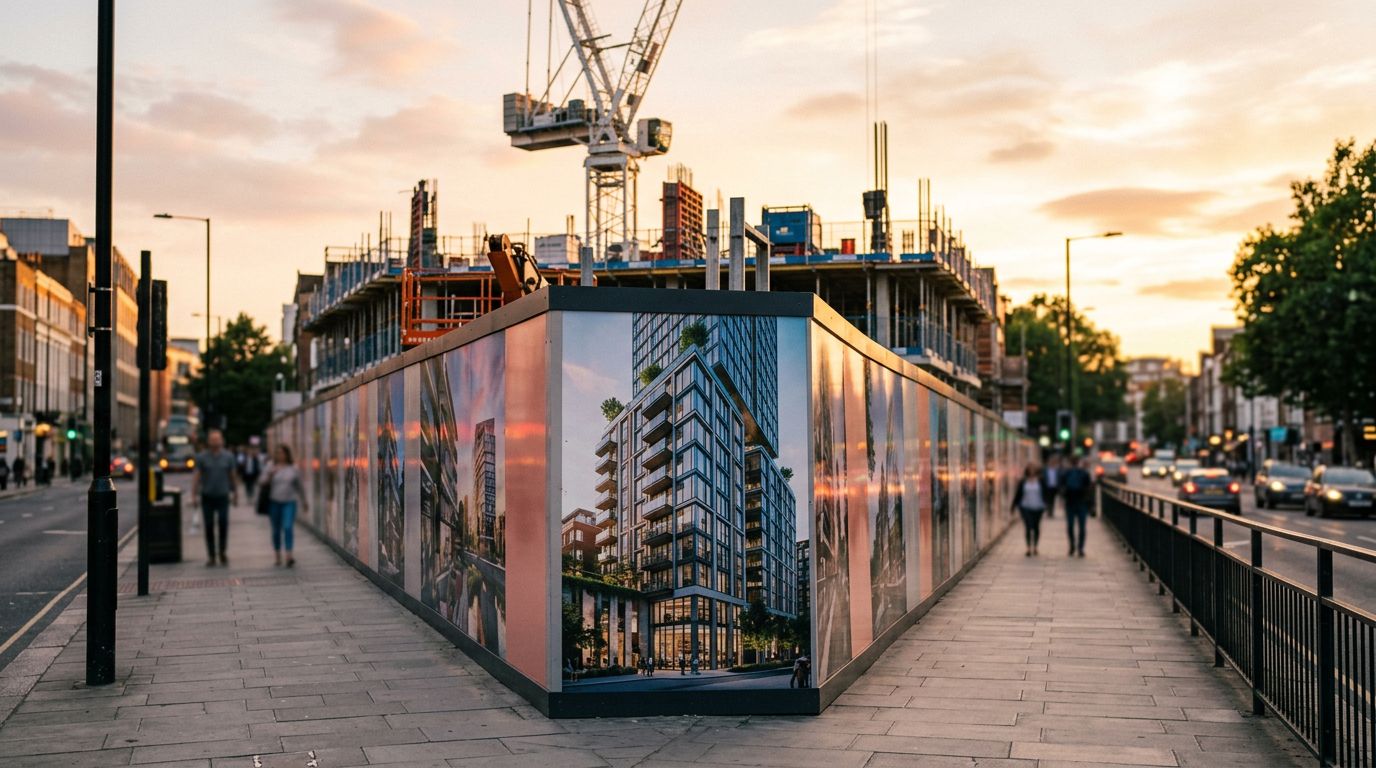
The global signage market is changing quickly, with projections showing a value of USD 56.0 billion by 2026. As The claim lacks context for "the industry"; the only matching forecast is for the food grade exopolysaccharides market, projected to grow at a 6.3% CAGR from 2026-2036 to reach USD 2.4 billion by 2036[1]. No general or other industry matches this exact rate through 2036., the focus has moved from simple identification to design that prioritizes experience. Property developers are moving away from basic site fences and choosing high-impact marketing assets instead. Using artistic renderings for property development signage is a strategic shift meant to create emotional engagement and community interest long before a project is finished.
Construction hoarding and site signage are the primary contact points for buyers and local neighbors. Using visual assets like watercolor sketches or copper linework allows developers to show a project's identity and lifestyle instead of only its physical dimensions. This guide looks at the technical and strategic use of artistic renderings in property development, focusing on the tools and methods used in 2026.
#01The Strategic Shift Toward Experience-First Signage
The role of site signage in 2026 goes far beyond safety and security. Industry experts view hoarding walls as strong marketing tools that start sales early. Recent data shows the move toward dynamic signage comes from a need for emotional impact. Research shows that people are more likely to support projects that tell a clear brand story through their physical surroundings. Organizations using AI architectural illustrations for developers find that artistic styles often work better than photorealistic renders in early stages because they let the viewer use their imagination.
Artistic renderings for signage make a construction site feel like a destination. By using specific styles, developers can reduce the visual mess of a building site. Experts at AGC Signs suggest that good branding and design can turn temporary hoarding into a promotional asset. This method shows off the project’s identity and keeps a good relationship with the community by adding beauty during the building phase.
#02Using AI for Scalable Visual Production
The technical environment for making artistic renderings has changed because of AI tools and fast rendering engines. Old workflows with V-Ray or Lumion needed long wait times and lots of money. In 2026, developers use platforms that cut turnaround times. Lumion Pro 2026 offers enhanced LiveSync for real-time PBR material synchronization and seamless CAD/BIM integration (e.g., with SketchUp, Revit), but does not include real-time ray tracing; alternatives like D5 Render and Enscape provide real-time ray tracing, which helps create visuals for whole city blocks quickly. Archfine is an AI-driven solution that turns sketches, floor plans, and 3D models into photorealistic renders, but the search results do not mention it supporting style transfer. Tools like ArchiVinci and D5 Render support turning sketches or renders into high-resolution renders using style transfer.[5][1][2]
Our Store, also known as HouseIllustrator, offers a specific solution. This is helpful for making matching signage panels. A developer might use the copper linework or minimalist styles from Our Store to create a uniform look across a 100-meter wall. This efficiency allows for regular updates to signage so the marketing stays current.
#03The Psychology of Artistic vs. Photorealistic Renders
Photorealistic 3D renders are used for technical checks, but artistic renderings for signage often have more psychological value in the early stages. Photorealistic images can feel cold, while artistic styles, like those seen in AI illustration vs traditional architectural rendering comparisons, suggest craft and vision. This softer approach works well for luxury projects where the goal is to sell a lifestyle.
By choosing styles like the classic villa sketch or watercolor render, developers can highlight the architectural goal and the mood of the project. These visuals focus on the feeling of the space rather than the specific texture of the wood. Experts at Readesigns note that high-quality visuals and clear messages build the excitement needed for off-plan sales. The goal is to provide enough detail to interest people while using artistic flair to inspire them, making the development feel like a part of the neighborhood instead of an outside structure.
#04Technical Standards for Large-Scale Signage Graphics
A major challenge in development signage is size. Graphics for hoarding and billboards need high resolution to look clear up close and from a distance. In 2026, The standard for professional graphics in wide-format printing is typically 100-150 dpi (not high-resolution like 300 dpi for small formats), due to greater viewing distances that allow lower resolution while maintaining quality. AI tools have improved here; they now produce professional assets that stay sharp even when they are several meters tall.
Our Store meets this need by offering High-Resolution Output for print. When making artistic renderings for signage, developers must make sure the AI understands architectural shapes to avoid errors. Using the comparison tool, marketing leads can check that the illustration reflects the property's proportions before printing. This precision is necessary for brand trust and ensures the signage matches the quality of the final building.
#05Integrating Environmental Graphics and Wayfinding
Good signage is more than just one main image. A complete approach involves environmental graphics, wayfinding, and community elements. RSM Design notes that good signage creates a welcoming feel during construction. This includes street signs and amenity signs that show the property's character. By using artistic renderings for these items, developers create a sense of place.
For property developer off-plan marketing illustrations, signage is a bridge between digital ads and the physical site. If a buyer sees an illustration style on social media, seeing that same style on the site hoarding strengthens the brand. This consistency builds trust and makes the project feel more real to the community. Adding QR codes to these panels lets people move from the physical sign to a digital brochure or booking, creating a connected marketing path.
#06Cost-Efficiency and ROI in 2026 Marketing
The cost of site marketing has changed with fast, low-cost rendering tools. In 2026, Nano Banana 2 pricing is significantly lower than the claimed range. As of March 2026, Nano Banana 2 costs $0.045 per image at 512px resolution and $0.151 per image at 4K resolution through Google's official API[1][3]. Even at maximum quality (4K), the cost is $0.151 per image, which is well below the $0.30–$1.00 range claimed. Using the Batch API for non-urgent workloads reduces 4K costs further to $0.0755 per image[1]. This lets small developers compete with big firms by making more content. The return on investment for high-quality signage is clear; good hoarding leads to more questions from buyers and faster sales.
Our Store makes this easier by removing the need for expensive photography or complex 3D models for every asset. By uploading a photo, the AI applies an artistic style instantly. This simple workflow (upload, choose style, download) lets marketing teams produce professional artistic renderings without special training. Compared to old methods, AI tools reduce costs while keeping quality high.
As the property market gets more competitive in 2026, the quality of marketing assets determines project success. Using artistic renderings for signage lets developers go beyond the limits of a construction site, turning hoarding into a brand story. Our Store (HouseIllustrator) helps teams create these visuals instantly, turning photos into high-resolution illustrations. To improve your project's presence and get more buyers interested, start using Our Store to transform your site imagery today.
Frequently Asked Questions
In this article
The Strategic Shift Toward Experience-First SignageUsing AI for Scalable Visual ProductionThe Psychology of Artistic vs. Photorealistic RendersTechnical Standards for Large-Scale Signage GraphicsIntegrating Environmental Graphics and WayfindingCost-Efficiency and ROI in 2026 MarketingFAQ