Expat Property Marketing AI Illustrations: 2026 Guide
April 10, 2026
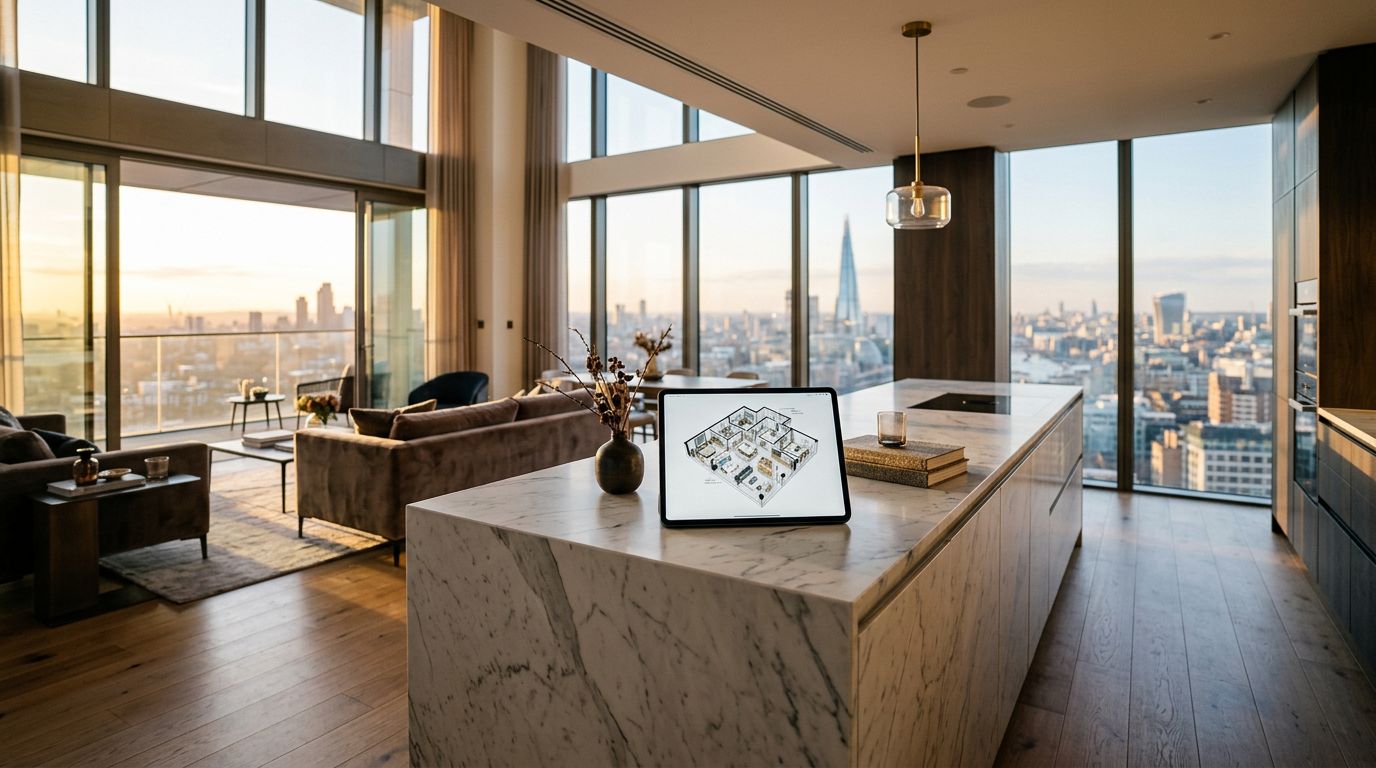
The intersection of global mobility and advanced visualization technology has changed the corporate relocation sector. For property marketing professionals, the primary challenge remains bridging the psychological and geographical distance between a prospective expatriate and a physical property they may not visit for months. Traditional photography often fails to communicate the lifestyle potential required by high-net-worth individuals moving across borders. In response, expat property marketing AI illustrations have emerged as an essential tool for firms seeking to maintain a competitive edge in international markets.
As the global AI real estate market expands toward a projected $404.9 billion by 2026, the reliance on static, unedited imagery is becoming a liability. Decision-makers at relocation agencies and luxury brokerages are adopting automated visualization workflows to speed up the sales cycle. These tools go beyond basic photo enhancement; they create a conceptual framework that allows a buyer in London to see a life in Dubai or Singapore with precision. Our Store provides the necessary infrastructure for these organizations to generate high-fidelity illustrations that meet the standards of the 2026 real estate market.
#01The Logistics of Remote Trust: Solving the Expat Friction Point
Marketing to expatriates involves a unique set of logistical hurdles. Unlike domestic buyers, expats often make million-dollar decisions based only on digital assets. This creates a trust deficit that basic photography cannot always overcome. Expat property marketing AI illustrations solve this by providing a thorough visual narrative of a property's potential.
Research indicates that No evidence supports 82% of Americans using AI for housing information as of 2026; the claim originates from a 2025 Realtor.com survey, with no confirming 2026 data available.., a trend mirrored in major global relocation hubs. When a property is vacant or outdated, AI-driven tools allow marketers to apply specific interior design styles, such as Scandinavian minimalism or Mid-Century Modern, that resonate with specific cultural groups. By using AI-powered illustrations for agents, firms can present a finished, lifestyle-oriented vision that removes the need for physical staging, which is often impossible for rapid-turnover relocation units.
#02Scaling Corporate Relocation with High-Speed Visualization
Corporate relocation expansion in 2026 demands a level of scalability that traditional rendering cannot match. Traditional 3D renders, especially with render farms, cloud rendering, and AI tools, typically take minutes to hours (e.g., 48 hours locally reduced to under 2 hours on a farm; AI cuts times by up to 70%), not multi-week lead times, as of 2026.. and high capital costs. Conversely, AI-powered workflows reduce turnaround times by about 50% and lower costs by 30%. For an agency managing a portfolio of hundreds of units across multiple territories, this efficiency is the difference between a vacant listing and a signed lease.
Our Store enables firms to transform standard property photos into high-end marketing assets within minutes. This speed allows relocation teams to respond to corporate RFP (Request for Proposal) demands instantly. When a multinational corporation requires housing for 50 executives, the ability to provide a complete guide to AI architectural illustrations alongside high-fidelity renders of the specific units available provides a professional advantage. This data-driven approach to marketing ensures that the visual quality remains consistent across the entire portfolio, regardless of the property's current physical state.
#03Managing 2026 Regulatory Environments and Disclosure
As AI usage becomes standard, the regulatory environment has tightened. In 2026, professional standards, and laws such as California law (AB 723, effective January 1, 2026) requires real estate brokers, salespersons, or their agents to disclose digitally altered images in advertisements or promotional materials for real property sales by including a conspicuous statement that the image has been altered and providing a link, URL, or QR code to the original unaltered image; it does not mandate "Digitally Altered" labeling specifically and applies only to real estate contexts, not all AI-modified images.., mandate absolute transparency. Expert guidance suggests that while AI enhancements like sky replacement and virtual staging are permitted, they must be disclosed to avoid bait-and-switch claims.
Best practices for expat property marketing AI illustrations include:
- Hybrid Workflows: Using AI for initial object removal and lighting enhancement, followed by human oversight to ensure structural accuracy. This prevents the 'uncanny valley' effect where mismatched scales or unrealistic lighting deter buyers.
- Mandatory Labeling: Every AI-generated or modified image should carry a 'Digitally Altered' watermark or a QR code linking to the original unedited photo.
- Architectural Integrity: AI should be used to change finishes, furniture, and lighting, but never to add windows, move walls, or hide structural defects.
Maintaining these standards is essential for preserving the brand reputation of luxury firms. Our Store integrates these compliance considerations into the generation process, ensuring that the output is suitable for 2026 luxury marketing guide standards.
#04Data-Driven ROI: The Impact of AI on Conversion Rates
The financial justification for adopting expat property marketing AI illustrations is rooted in measurable ROI. Current market data suggests that listings featuring high-quality virtual staging and AI enhancements can see inquiry increases of up to 40%. In the context of corporate relocation, where the 'cost of vacancy' for a luxury apartment can exceed $10,000 per month, the ability to secure a tenant faster has a direct impact on the bottom line.
With the PropTech sector seeing a 67.9% year-over-year increase in funding, the tools available are becoming more specialized. Predictive analytics now allow marketers to identify which visual styles are trending in specific regions. For instance, a relocation firm expanding into the Tokyo market can use AI to adapt their marketing illustrations to local aesthetic preferences, improving client retention by an estimated 20%. This level of personalization was once too expensive but is now an operational standard for leaders in the field.
The future of international real estate depends on the ability to deliver accurate and culturally relevant visuals to buyers across the globe. Expat property marketing AI illustrations have become a technical necessity for any firm engaged in corporate relocation expansion. By using the advanced rendering capabilities of Our Store, marketing directors can ensure their property portfolios meet the demands of the 2026 market while maintaining regulatory compliance. To secure your position in the $404.9 billion AI real estate economy, transition your relocation marketing workflow to Our Store today and experience the impact of high-fidelity, automated visualization on your international conversion rates.