Property Development Hoarding AI Illustration Guide
April 10, 2026
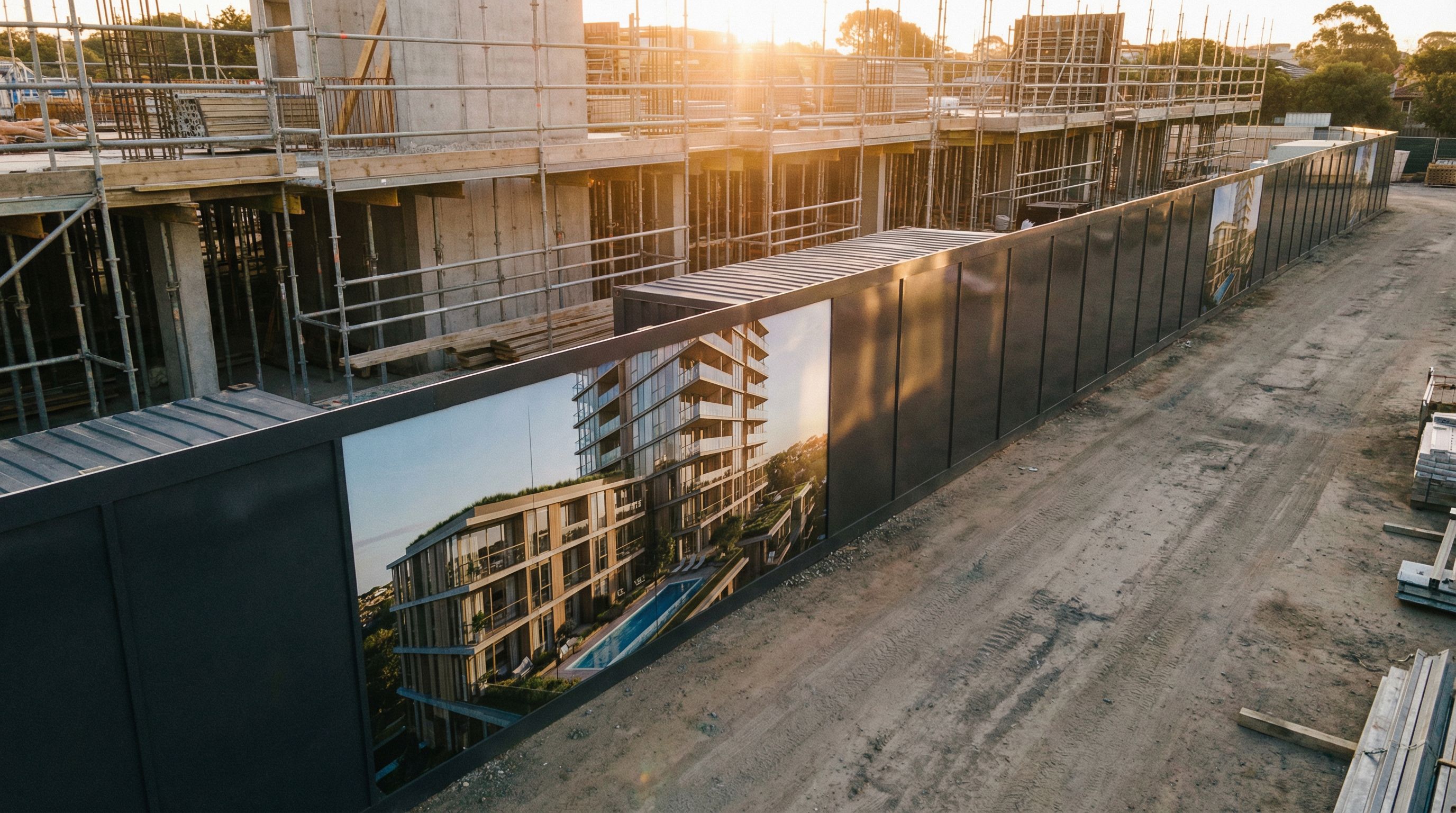
Property development hoarding has historically functioned as a passive barrier, primarily serving site security and safety requirements. However, the integration of high-fidelity artificial intelligence has transformed these physical boundaries into high-performance marketing assets. In 2026, property development hoarding AI illustration represents a critical shift in how developers communicate project vision to stakeholders and the public long before a single brick is laid.
Traditional CGI (Computer Generated Imagery) often required weeks of lead time and significant capital expenditure, making it difficult to update visuals as project specifications evolved. Modern AI workflows allow for the rapid generation of photorealistic exteriors and site-specific overlays that can be deployed across large-scale construction signage within hours. This efficiency enables developers to maintain marketing momentum and adapt to changing market conditions with unprecedented agility.
#01The Evolution of Construction Site Signage and AI Disruption
The transition from standard plywood barriers to sophisticated digital and printed hoarding has been accelerated by the democratization of architectural visualization tools. In the previous decade, only tier-one institutional developers could afford high-end site wraps featuring photorealistic renders. Today, the adoption of property development hoarding AI illustration allows mid-market and boutique firms to produce identical quality, leveling the competitive landscape.
Recent industry data indicates that developers utilizing AI-driven visualization for site marketing report a 70% to 80% reduction in design time compared to traditional 3D rendering pipelines. Rather than waiting for a centralized studio to model every facet of a building, technical leads now use AI to 'upscale' architectural massing directly into high-resolution graphics suitable for wide-format printing. This technological leap ensures that the hoarding remains current, reflecting the most recent design iterations and landscape plans.
Furthermore, the psychological impact of high-quality hoarding cannot be overstated. Passersby are no longer viewing a 'coming soon' sign; they are experiencing a visual representation of a completed environment. This creates a sense of place and community before construction milestones are even met, which is essential for maintaining public support and managing local expectations during the disruptive phases of development.
#02Leading AI Tools for Hoarding Design in 2026
Selecting the appropriate software stack is paramount for generating high-resolution, architecturally accurate illustrations for large-scale signage. For 2026, three primary tools have emerged as industry standards: Midjourney v7, Veras, and Rendair AI.
Midjourney v7 remains the benchmark for artistic concept generation and environmental mood boards. Its latest iteration has reduced geometry 'hallucinations' by 40%, making it significantly more reliable for depicting complex facades. When prompted with specific architectural styles—such as 'Modern Brutalist high-rise with glass curtain walls and integrated vertical forests'—it generates hyper-realistic textures that are ideal for the atmospheric sections of a hoarding wrap.
Veras serves a different function by integrating directly into Building Information Modeling (BIM) software like Revit, SketchUp, and Rhino. This allows developers to take an actual working model and apply an AI-driven rendering layer that maintains the structural integrity of the design. For technical leads, this ensures that the property development hoarding AI illustration is not just a 'pretty picture' but a faithful representation of the planned structure.
Rendair AI has gained traction for its speed in processing drone-captured site photos. It allows developers to upload a photograph of a muddy construction site and overlay a completed rendering onto the existing context. This 'before-and-after' capability is a powerful tool for site-specific hoarding, as it helps viewers visualize exactly how the new development will sit within the current streetscape.
#03Maximizing Off-Plan Sales Through AI Visualization
The primary objective of most property hoardings is the acceleration of off-plan sales. In 2026, the use of property development hoarding AI illustration is the primary driver of early-stage capital recycling. By showcasing finished interiors and amenity spaces on the site's exterior, developers can capture leads at the exact moment potential buyers are physically present at the location.
Case studies from recent residential booms, particularly in high-growth areas like Utah and Florida, demonstrate that AI-generated visuals can replace slow, traditional CGI workflows to launch sales campaigns months earlier. When a hoarding displays a photorealistic 8K render of a future rooftop lounge or a designer kitchen, it bridges the gap between a hole in the ground and a high-value investment.
To optimize conversion, developers should implement QR codes on the hoarding that lead to immersive landing pages. These pages can host further AI-generated content, such as virtual staging or decluttered versions of current site photos. The ability to 'surgically' remove construction debris from a photo and replace it with aspirational landscaping via AI creates a frictionless path to purchase. For more on this strategy, see our guide on Architectural Illustrations for Real Estate Marketing.
#04Technical Workflow: From Architectural Plan to Wide-Format Print
Creating a property development hoarding AI illustration requires a structured workflow to ensure the final output is suitable for the massive physical scale of site signage. Hoardings often exceed 2.4 meters in height and can span hundreds of meters in length; therefore, image resolution and pixel density are critical concerns.
- Massing and Context: Begin with a basic 3D model or a high-resolution photo of the current site. Tools like Veras are essential here to ensure that the building's scale is accurately represented relative to neighboring structures.
- AI Layering: Use image-to-image prompts to apply materials, lighting, and environmental factors. In 2026, the 'Seed' parameter in tools like Midjourney is used to maintain visual consistency across multiple panels of the hoarding.
- Upscaling for Large Format: Standard AI outputs are rarely high-resolution enough for physical hoarding. Technical leads must use dedicated AI upscalers to reach the 150-300 DPI (dots per inch) required for large-scale printing. This prevents pixelation and ensures that the textures—such as brickwork or wood grain—remain crisp at close range.
- Branding Overlay: Once the render is finalized, it is imported into vector-based design software to add logos, contact information, and mandatory safety warnings. For a deeper look at the transition from photography to art, refer to our AI Architectural Illustration From Photos: Complete Guide.
#05Site-Specific 3D Overlays and Virtual Staging
One of the most advanced applications of property development hoarding AI illustration is the use of site-specific 3D overlays. This technique involves taking a real-world photograph of the land and using AI to 'anchor' a 3D model of the proposed building into that specific environment. This provides a level of contextual accuracy that traditional renders often lack.
For example, tools like Nano Banana allow custom home builders and large-scale developers to place a future structure into a drone shot of the site, complete with accurate shadows and reflections from surrounding buildings. On a hoarding, this visual proof-of-concept reduces buyer skepticism and demonstrates a commitment to architectural harmony.
Virtual staging also plays a role in hoarding design. Developers can showcase multiple 'interior vibes'—from minimalist Scandinavian to industrial chic—on different sections of the hoarding wrap. This broadens the project's appeal by showing that the spaces are adaptable to various lifestyles. This method is particularly effective for Pre-Selling Homes with Architectural Illustrations, as it allows the hoarding to do the heavy lifting of the sales pitch 24/7.
#06ROI Analysis: The Economic Impact of AI Signage
Investing in property development hoarding AI illustration is a data-driven decision for modern developers. The ROI is realized through two primary channels: cost savings in production and increased velocity in sales.
Traditional architectural rendering for a full-site hoarding wrap could historically cost between $5,000 and $20,000, depending on the number of views and the complexity of the scene. In contrast, an internal team using a Pro subscription to an AI platform ($60/month) can generate a comparable range of visuals in a single afternoon. This represents a cost reduction of over 95% in the visualization phase alone.
From a sales perspective, the high-fidelity nature of AI renders increases lead quality. Buyers who engage with a hoarding that accurately depicts the finished product are further down the sales funnel when they contact the agency. Institutional developers are now restructuring their marketing budgets to prioritize these AI workflows over traditional pilots, focusing on scalability and speed to market. This trend is especially prevalent in the luxury sector, as detailed in our AI Property Developer Off-Plan Marketing Illustrations guide.
#07Future Trends: Interactive and AR-Enhanced Hoardings
As we look beyond 2026, the property development hoarding AI illustration will likely integrate with Augmented Reality (AR) to create interactive site boundaries. Future hoardings will act as 'anchors' for AR experiences, where a passerby can point their smartphone at a printed AI illustration and see a 3D walkthrough of the building appear in real-time over the construction site.
Moreover, the use of generative AI will allow for 'dynamic' hoardings in digital formats. In high-traffic urban centers, LED hoardings could change their AI-generated visuals based on the time of day, showing the building in golden hour light during the evening commute and bright morning sun during the early hours. This level of hyper-personalization and environmental awareness will further solidify AI's role as the indispensable tool for property marketing and urban development.
The adoption of property development hoarding AI illustration has moved from an experimental technique to an industry standard for successful site marketing. By leveraging tools like Midjourney v7 and Veras, developers can produce high-resolution, contextually accurate visuals that accelerate off-plan sales and improve public perception of construction projects. To remain competitive in 2026, organizations must integrate these AI-driven workflows into their standard development cycle, ensuring that site signage is as innovative as the structures being built.
Frequently Asked Questions
In this article
The Evolution of Construction Site Signage and AI DisruptionLeading AI Tools for Hoarding Design in 2026Maximizing Off-Plan Sales Through AI VisualizationTechnical Workflow: From Architectural Plan to Wide-Format PrintSite-Specific 3D Overlays and Virtual StagingROI Analysis: The Economic Impact of AI SignageFuture Trends: Interactive and AR-Enhanced HoardingsFAQ