Jerusalem Off-Plan Property AI Illustrations Guide
April 10, 2026
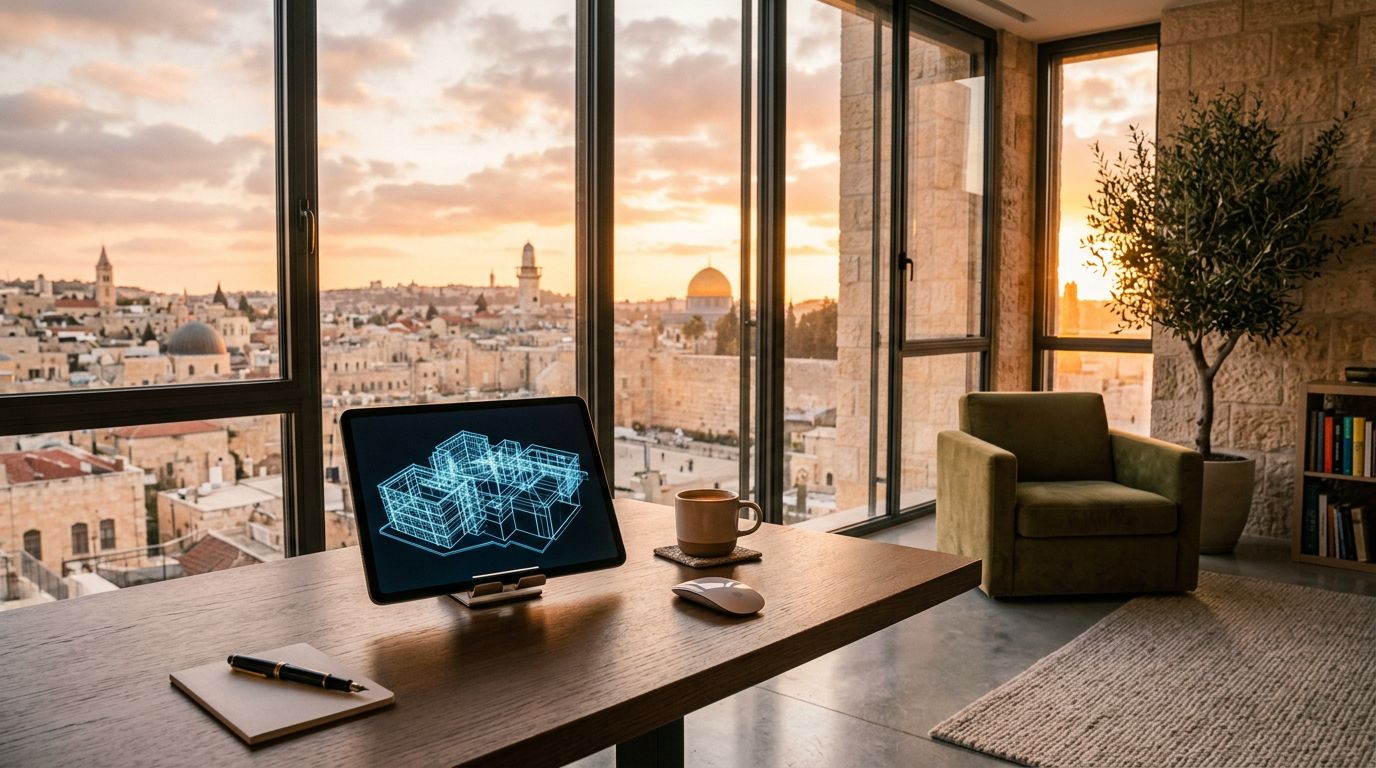
The Jerusalem real estate market in 2026 is characterized by a significant expansion in residential development, with city authorities having approved over 7,700 housing units in the past year alone. This surge is part of a broader pipeline expected to deliver more than 50,000 units by the end of the decade. However, the market faces a dual challenge: a massive unsold inventory of approximately 84,000 units nationwide and a persistent labor shortage in the construction sector. For property developers in Jerusalem, the ability to secure pre-sales for off-plan projects has never been more critical to maintaining liquidity and project momentum.
Traditional marketing methods, which often rely on static, expensive architectural renders, are increasingly insufficient in a competitive landscape where buyers demand higher levels of transparency and personalization. Enter Jerusalem off-plan property AI illustrations—a suite of advanced visualization tools that allow developers to generate high-fidelity imagery and interactive experiences at a fraction of the traditional cost. By leveraging artificial intelligence, developers can now provide prospective buyers with a tangible vision of unbuilt spaces, bridging the psychological gap between a technical floor plan and a future home.
#01The Evolution of Off-Plan Marketing in Jerusalem
Historically, selling off-plan property in Jerusalem required a significant leap of faith from the buyer. Marketing materials were limited to technical blueprints and a handful of high-priced 3D renders that took weeks to produce. In the current 2026 market, the standard has shifted. Organizations leveraging automated visualization workflows have seen a marked increase in engagement from both local and international investors. The primary driver for this shift is the need to move inventory faster in a high-supply environment.
Jerusalem off-plan property AI illustrations facilitate a dynamic sales process. Rather than presenting a single vision of an apartment, developers can now use tools like Rendair AI to generate multiple aesthetic variations of a unit in minutes. This agility is essential for addressing the diverse buyer pool in Jerusalem, which includes local families, secular professionals, and the international Haredi community. Each demographic has distinct preferences for interior finishes and layouts. AI allows marketing teams to tailor visuals to the specific prospect, showing a modern minimalist kitchen to one buyer and a traditional, larger dining area suitable for Shabbat hosting to another, all without the need for a full architectural redesign.
#02Remote Buyer Engagement Through Interactive AI
A substantial portion of Jerusalem’s off-plan sales is driven by foreign investors and members of the Jewish diaspora. For these buyers, the inability to physically visit a construction site is a significant barrier. Israeli-founded technology like HIWAY has revolutionized this aspect of the market. Unlike traditional virtual tours, these AI-driven platforms allow for real-time redesigns during a remote walkthrough. A buyer in New York or London can virtually navigate an unbuilt Jerusalem apartment and instantly see how different flooring or cabinetry would look.
This level of interactivity builds trust, which is the most valuable currency in off-plan sales. When a buyer can 'interact' with the space, their emotional connection to the property strengthens. Furthermore, these tools integrate with existing property management systems and Real Estate CRM AI Illustration Workflow Guide protocols, ensuring that the visuals shared during a sales call are recorded and aligned with the buyer's stated preferences. This data-driven approach to visualization ensures that the sales team is not just showing a generic render, but a personalized vision of the buyer's future asset.
#03Technical Workflow: From Floor Plans to Photorealistic Art
The technical process of generating Jerusalem off-plan property AI illustrations is significantly more efficient than legacy 3D modeling. The workflow typically begins with a standard 2D CAD file or a simple hand-drawn sketch of a floor plan. Tools such as Rendair AI use 'sketch-to-render' technology to extrude these 2D shapes into 3D environments. By applying specific prompts related to 'Jerusalem stone' facades and local light conditions, the AI generates images that feel authentic to the city's unique architectural character.
For developers, the economics of this workflow are transformative. Traditional rendering can cost thousands of dollars per image and involve long feedback loops. In contrast, AI image generation tools now operate at costs under 1 ILS per graphic. This allows for the mass production of marketing collateral for every single unit in a development, rather than just a 'typical' apartment. When every listing on a portal is accompanied by high-quality, unit-specific AI Illustrations for Apartment Listings, the click-through rate and lead quality improve significantly. This technical efficiency is particularly vital for New Build Property Illustration AI Marketing strategies where speed to market is a competitive advantage.
#04Addressing Jerusalem’s Unique Architectural Requirements
Jerusalem is not a standard real estate market; it is a city of strict building codes and deep historical significance. Every new development must adhere to regulations regarding the use of Jerusalem stone and must often blend into sensitive urban contexts. AI illustration tools in 2026 have become sophisticated enough to respect these parameters. Specialized models can be trained on local architectural styles, ensuring that the Heritage Property AI Illustration Marketing remains respectful of the surrounding environment.
Developers working on urban renewal projects—known locally as Pinui Binui—use AI to show residents how their revamped neighborhoods will look. This is a critical step in the approval process. By showing a photorealistic AI Renovation Visualization of a current dilapidated block transformed into a modern residential complex, developers can win the support of existing tenants and local planning committees. The AI’s ability to render complex textures like aged limestone and specific Mediterranean landscaping ensures that the visualizations are not just beautiful, but culturally and legally accurate.
#05ROI and Market Conversion Data
The impact of high-quality visualization on sales performance is quantifiable. Market data from late 2025 and early 2026 suggests that projects utilizing comprehensive AI-generated visual suites achieve pre-sale targets 25-30% faster than those relying on traditional renders. This is partly due to the ability to flood social media and property portals with diverse content. A single unit can be represented through Pencil Sketch Real Estate Listings for an artistic touch, or high-end Oil Painting Style Real Estate AI for luxury penthouses.
Moreover, the cost savings contribute directly to the project's bottom line. By reducing the visualization budget by up to 80%, developers can reallocate those funds toward targeted digital advertising or enhanced sales center technologies. The AI Illustration ROI for Real Estate Agents is particularly high in Jerusalem’s luxury sector, where the expectations for marketing materials are exceptionally high. For developers managing multiple projects, the ability to centralize illustration production through AI SaaS platforms provides a level of scalability that was previously impossible.
#06Strategic Integration into Sales Centers
The physical sales center remains a staple of the Jerusalem property market, but its role is changing. In 2026, leading developers are replacing physical scale models with AI Property Illustrations for Sales Centers. Large-format touchscreens allow potential buyers to explore every corner of a project. These displays are powered by real-time rendering engines that can adjust the time of day, showing how the afternoon sun hits a balcony in Rehavia or Talbiyeh.
This integration extends to the documentation provided to buyers. Instead of a generic brochure, prospects receive a digital 'lookbook' of the specific unit they are interested in, featuring AI-generated views from their future windows. This is often combined with AI Tools for Real Estate Brochures to ensure that the branding and technical specifications are perfectly aligned. By providing a personalized, high-tech experience, developers position themselves as forward-thinking and reliable, which is essential for closing million-dollar off-plan transactions.
As Jerusalem continues its unprecedented construction boom, the competition for off-plan buyers will only intensify. The adoption of AI-driven illustration tools is no longer a luxury but a strategic necessity. By providing photorealistic, customizable, and cost-effective visualizations, developers can overcome the challenges of unsold inventory and remote buyer hesitation. Whether you are marketing a luxury boutique project in the German Colony or a massive urban renewal development in Kiryat HaYovel, Jerusalem off-plan property AI illustrations offer the most efficient path to securing pre-sales and ensuring project success in 2026.