AI Illustration for Property Investment Deck: 2026 Guide
April 11, 2026
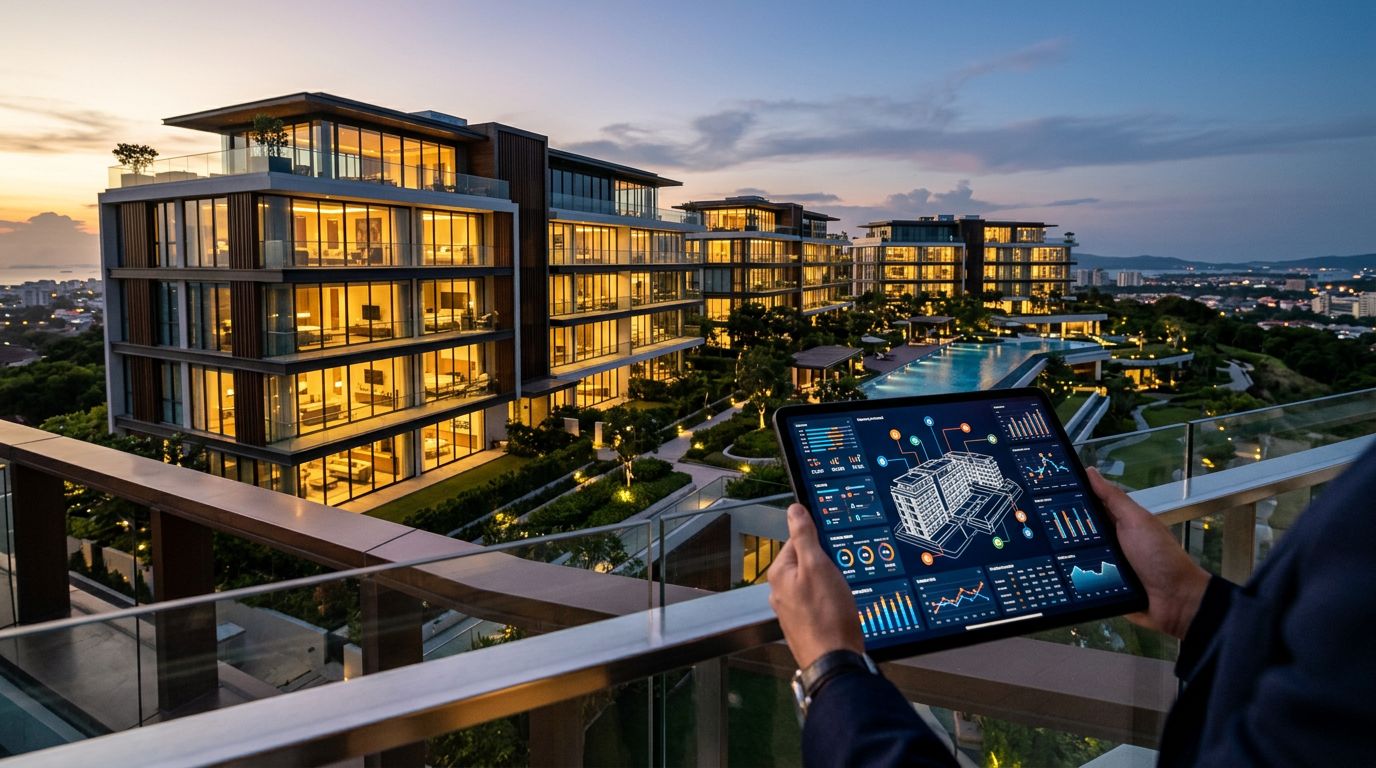
The real estate investment sector in 2026 relies on data speed and high-quality visual storytelling. As global PropTech funding hit $16.7 billion in 2025, capital has moved into generative AI platforms that improve investor communications. Static offering memorandums (OMs) are shifting toward dynamic presentations that use AI illustrations for property investment decks to show value better than traditional photos alone. Investment committees and wealthy individuals now want more precision than standard mockups offer. By combining market data, automated valuation models (AVMs), and sharp artistic renders, sponsors can show a complete vision of a property. This 2026 guide looks at the technologies and workflows needed to create professional investment materials for the global market.
#01The Rise of AI in Property Investment Marketing
The global AI market for real estate grew to $303 billion in 2025. Projections show this sector reaching $989 billion by 2029, a 34.4% CAGR. This growth happens because AI automates manual work. Morgan Stanley reports that AI will likely automate about 37% of real estate tasks by 2030, creating $34 billion in efficiency gains. For investment professionals, this change is most obvious in pitch decks. Using AI architectural visualization for real estate allows for fast visual generation that matches financial data. Instead of waiting weeks for architectural drawings, sponsors use AI to turn site photos into illustrations that fit the fund's branding. This speed helps in high-interest-rate environments where capital windows close fast.
#02Technical Precision: Integrating AVMs into Visual Assets
In 2026, the gap between visual mockups and financial reality has closed. AI automated valuation models (AVMs) now have a median error rate of 2.8%, down from 10 to 15% in the past. This accuracy lets investors use property investment deck illustrations that are both aesthetic and rooted in live data. Modern platforms pull real-time rent and sales data for specific areas, like Westlake multifamily or London commercial hubs, to create pro formas that update deck visuals automatically. HouseIllustrator helps with this by providing professional illustrations paired with these data points. For instance, a sponsor can show a 'Classic Villa Sketch' style render of an asset next to a 2025 sales chart. This detail reduces risk by giving investors a clear, data-driven look at the asset's state and future.
#03Automating the Investor Pitch: 2026 Workflow
Efficiency in 2026 involves turning a raw rent roll into a finished investor presentation in hours. CRE professionals use multi-tool AI workflows. The process starts with an AI agent like Claude PowerPoint or Henry AI to extract metrics from an OM and build pro formas for internal rates of return (IRR). Once the financial structure exists, the visual layer is added. Specialized tools like HouseIllustrator are useful here. By uploading property photos, users can generate high-resolution illustrations in styles like 'copper linework' or 'minimalist line illustration' for a uniform look across a portfolio. This replaces expensive custom decks with systems that create slides in minutes. The result is a polished artistic property render that keeps brand consistency and allows for weekly updates.
#04Visualizing Potential: Renovations and Off-Plan ROI
Investment decks often sell a future state. In value-add multifamily deals or ground-up developments, seeing the 'after' is necessary to get commitments. AI illustrations provide realistic overlays for renovations, showing new flooring or structural changes, without the cost of 3D rendering. For developers, AI for off-plan property marketing illustrations helps create site plans and masterplan visuals that can change based on investor feedback. Tools like Rendair AI and HouseIllustrator show 'before and after' comparisons. When an investor sees a warehouse become a modern workspace via a slider tool, the ROI story is clearer. This visualization of value is often the deciding factor in raising capital.
#05Strategic Competitive Edge in the 2026 Market
In 2026, AI is common, so investors want utility over novelty. They require custom visuals that match the specific market and asset class. Customizing AI illustrations for an investment deck ensures the tone fits the thesis. A luxury residential fund might use a 'Classic Villa Sketch,' while a logistics fund uses 'Copper Linework.' Using these tools also offers a cost advantage. Firms using automated deck creation report cost reductions of 17.6% and energy savings in smart building projections due to better predictive visuals. By cutting marketing overhead, firms can put more resources into due diligence and asset management to deliver better returns.
The change in property investment decks shows a move toward data transparency and better aesthetics in real estate. In 2026, generating high-quality visuals quickly is a requirement for firms seeking institutional capital. HouseIllustrator bridges the gap between property photos and the professional illustrations investors expect. By turning photos into high-resolution artwork quickly, HouseIllustrator makes pitch materials as strong as the financial data. Improve your next capital raise by adding professional AI-powered illustrations to your investment workflow today.